
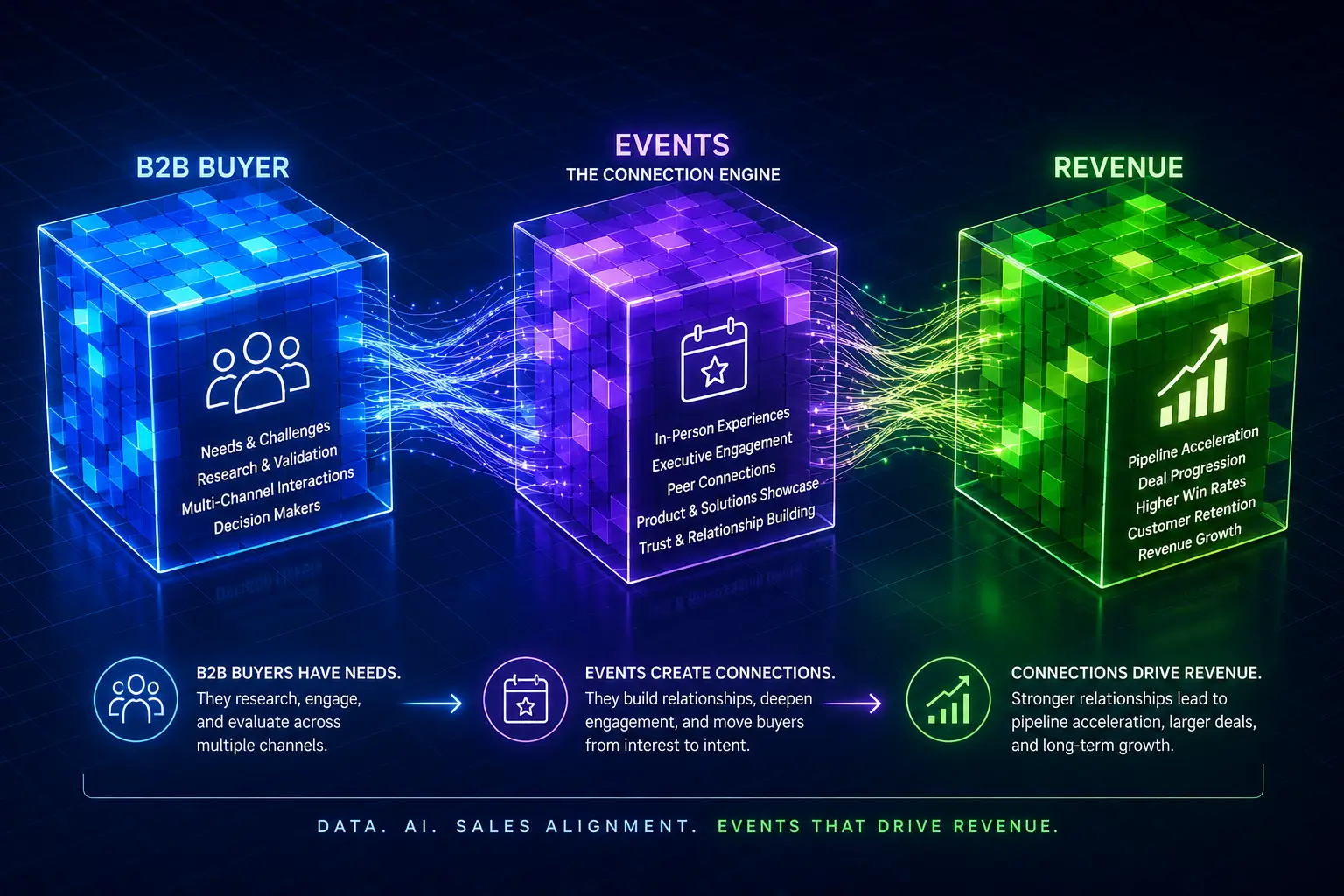
The McKinsey research on B2B growth is a strong validation of something top performing field marketers have known for years: events are not being replaced by digital, they are becoming more important than ever as part of an integrated revenue engine.
Key Takeaways from the Study
1. The New B2B Growth Formula
According to McKinsey, companies outperforming their peers are building growth around three connected capabilities:
- Hyperpersonalization – highly tailored experiences for individual accounts
- AI at scale – using AI to improve targeting, engagement, and execution
- Sales-led account governance (ABM) – clear ownership and accountability for revenue
The real advantage doesn’t come from any one capability. It comes from integrating all three into a unified commercial system.
2. Buyers Still Want Human Interaction
One of the most important findings:
B2B buyers divide their interactions almost equally across in-person, remote, and digital channels.
McKinsey calls this the “Rule of Thirds.”
Buyers use an average of 10 channels during the purchasing journey and expect to move seamlessly between them.
Translation:
- Digital is essential.
- AI is essential.
- But human relationships remain equally important.
In fact, McKinsey reinforces the idea that:
“Business moves at the speed of trust.”
For complex enterprise purchases, buyers continue to prefer human interactions when stakes, deal size, and risk increase.
This is exactly where field marketing and events create disproportionate value.
3. Events Are a Major Differentiator for Personalization
McKinsey found the largest performance differences between leaders and laggards occur during:
- Social engagement
- Chatbot interactions
- Events
Why?
Because events create opportunities for:
- Account-specific experiences
- Executive engagement
- Industry-specific conversations
- Peer networking
- Product demonstrations
- Trust-building moments
The highest-performing companies are no longer running generic events. They are creating highly personalized experiences for strategic accounts and buying committees.
4. Sales and Marketing Alignment Is No Longer Optional
One of the strongest findings in the study:
Organizations with sales-led ownership of ABM activities were significantly more likely to achieve higher revenue growth.
McKinsey found that market leaders:
- Assign clear account ownership
- Align incentives across teams
- Measure account-level performance
- Integrate marketing activities directly into sales motions
The takeaway for field marketers:
Events should not operate as standalone marketing programs.
The most effective programs are built jointly with:
- Sales leadership
- AEs
- SDRs
- Customer Success
- RevOps
When sales owns the account strategy and marketing owns the experience strategy, pipeline acceleration becomes measurable and repeatable.
5. AI Makes Events More Effective, Not Less Relevant
The study positions AI as an amplifier—not a replacement for human engagement.
AI enables:
- Better account selection
- Personalized invitations
- Meeting recommendations
- Content customization
- Follow-up prioritization
- Pipeline analysis
But the actual relationship-building still happens through conversations, meetings, executive roundtables, dinners, and customer events.
The winning formula is:
AI + Personalization + Human Connection
Not one or the other.
https://www.mckinsey.com/capabilities/growth-marketing-and-sales/our-insights/the-surprising-economics-of-b2b-growth-the-new-survival-threshold-and-what-it-takes-to-thrive
ya,im here
Kingjlapp’s app is super convenient. I can play anywhere, anytime! Download it and try it! Download it here: kingjlapp
9fgeme… haven’t heard of this one before. Anyone got the inside scoop? Is it legit and worth a look? Intrigued! Learn more at 9fgeme
JLJLGameLogin sounds super targeted! Hoping it’s got a smooth and seamless login experience. Ain’t nobody got time for laggy logins when they tryna get their game on. Speedy access = happy gamer. Login now: jljlgamelogin
I have tested dozens of platforms and this one keeps surprising me with its consistent performance. The security measures give me total peace of mind while the entertainment value keeps me coming back. Quick payouts and a clean design make it my current favorite. mmshwe666
Playing from South America I always struggle to find sites that support my local payment methods but this platform makes it so easy. Deposits go through instantly and the live dealers really bring the Vegas vibe to my living room. A solid choice for serious players. casinopinupchile
The best spot for players looking for reliable entertainment. I appreciate the local payment options and the 24/7 chat team that actually understands our preferences. Safe and super convenient. vn22bet22
[623830]supplies professional anti-violence equipments and solutions for the whole world with strong and perfect production capacity. anti-violence.org
Using PayID here makes depositing and withdrawing a breeze since everything clears in just a few seconds. I do not have to wait hours for my winnings to land in my actual bank account anymore. It is hands down the smoothest way for Aussie players to fund their fun. payidcasinoaustralia
The live dealer section here is absolutely top notch and the support team responds really quickly. I love how they rotate their daily promotions and the withdrawal process took less than a day. Definitely my go to site for evening sessions. 77p777bet
Honestly I was skeptical at first but this platform completely won me over. The interface is clean and navigating through the games feels so natural. You can really feel the team cares about player satisfaction and keeps things safe. sihirjitulogin
[3625]ck44 Official Login | বিকাশ ডিপোজিট ও সেরা স্লট গেমস,ck44 অ্যাপ ডাউনলোড করে অনলাইন ক্যাসিনো খেলার নিয়ম জানুন এবং বিকাশ দিয়ে সহজ ডিপোজিট করে সেরা স্লট গেমস উপভোগ করুন। আজই জয়েন করুন। visit: ck44
The selection of slots is amazing and everything loads so quickly on my phone. Perfect for playing while commuting. Check out boga88slot
Best local platform for Jili fans. The promotions are tailored perfectly and the community is great. I’m sticking with phjili178 for sure.
The app version is so much better than the browser. It is fast, secure, and very convenient for gaming on the go via superjililoginapp.
If you love a classic casino feel with modern twists, this is it. The bonuses are actually generous. Give royal777game a try, you won’t regret it.
[4740]slotsmagic Official Login | সেরা অনলাইন স্লটস গেম এবং বিকাশ ডিপোজিট,slotsmagic-এ আজই জয়েন করুন। সহজেই অ্যাপ ডাউনলোড করে সেরা স্লটস গেম খেলুন এবং বিকাশ দিয়ে দ্রুত ডিপোজিট করে অভিজ্ঞতা নিন। এখনই লগইন করুন। visit: slotsmagic
Really impressed with the variety of games here. It is refreshing to find a site that actually pays out on time. Cheers to bdkhela888 for the awesome service.
Had a really smooth experience signing up and starting to play. The promotions are quite generous for new players. Highly suggest krwin2888.
I had some trouble logging in at first but their support team fixed it in minutes. The site is stable and the odds are very competitive. Try macan123login.
Such a fun community and the daily rewards keep me coming back. Definitely join the fun at no88club.
The login process is super fast and I never have issues accessing my account. Very stable platform overall. Glad I found phph143comlogin.
I’ve been playing here for a week and the payouts are surprisingly fast. Definitely one of the smoother experiences I’ve had lately. Check out inyou777 for a great time!
Finally found a source that actually works without any glitches. The download speed is impressive and the installation was a breeze. Big thanks to in7download for making this so easy.
[23]enzocasino লগইন এবং বিকাশ পেমেন্ট অনলাইন স্লট গেম সাইট,enzocasino লগইন করার নিয়ম জানুন এবং অ্যাপ ডাউনলোড করে লাইভ ক্যাসিনো খেলার নিয়ম আয়ত্ত করুন। বিকাশ দিয়ে অনলাইন ক্যাসিনো গেম শুরু করতে আজই যোগ দিন। visit: enzocasino
[2342]lotoquebec লগইন এবং বিকাশ দিয়ে ক্যাসিনো অ্যাপ ডাউনলোড,lotoquebec login করার নিয়ম জানুন এবং সহজেই অ্যান্ড্রয়েড ক্যাসিনো অ্যাপ ডাউনলোড করুন। বিকাশ দিয়ে ক্যাসিনো ডিপোজিট করে স্লট গেম শুরু করতে আজই যোগ দিন। visit: lotoquebec
Best experience so far in the PH region. The games are fair and the customer support is actually helpful. Highly recommended for everyone! phjuan635
Quick deposits and even quicker withdrawals. That is all I really care about and they nailed it. Trust idhura500 for your wins.
Super impressed with the VIP treatment here. The bonus rounds are exciting and I feel like a winner every time I log in to krkrvipkrvip125
[7984]bet365 লগইন এবং অ্যাপ ডাউনলোড | বিকাশ ক্যাসিনো গেম সাইট,bet365 login করার নিয়ম জানুন এবং অ্যাপ ডাউনলোড করুন। বিকাশ দিয়ে অনলাইন ক্যাসিনো ডিপোজিট করে লাইভ ক্যাসিনো খেলার নিয়ম শিখুন ও আজই শুরু করুন। visit: bet365
I love how easy it is to manage my account here. No complicated steps just straight to the action. mega303login makes gaming so much simpler.
The room is a perfect circle of black marble. A single spotlight illuminates two chairs. One is ornate, gilded, empty. The other is simple, steel, occupied by MOHAMMED BIN SALMAN, 40, still wearing the pristine white thawb he died in. He looks impatient.
Across from him, CROWLEY WOLF, 50s, dressed in a threadbare velvet smoking jacket, paces slowly, holding a small, leather-bound director’s script. He stops, turns, and his voice booms, filling the vast, empty space.
CROWLEY WOLF
(Not shouting, but with immense, theatrical volume)
You’re late. The curtain rose an eternity ago. You think power makes you immune to time? Here, time is the only critic that matters. And it has found your performance… lacking. You’re playing the role of “Crown Prince.” Act like it. Sit up.
Mohammed shifts, his arrogance a physical shield.
MOHAMMED BIN SALMAN
I do not answer to stagehands. I am the Crown Prince of Saudi Arabia. This… interrogation is a mistake. A grotesque misunderstanding.
CROWLEY WOLF
(Waving a dismissive hand)
Mistake? There are no mistakes, only bad choices followed by worse acting! “I am the Crown Prince.” The line is delivered with the conviction of a man reading a shopping list. Again! From the entrance! You sweep in! You own the room! You are the vessel of a nation’s destiny! FEEL IT, YOU BLITHERING INCOMPETENT!
MOHAMMED BIN SALMAN
(Icy)
I am the Crown Prince of Saudi Arabia. My destiny is not a matter for your… amusement.
CROWLEY WOLF
(A cruel smile)
Better. A flicker of something. Not belief, but the memory of it. Good. We can work with that. Let’s talk about your props. Your toys. This… “Directed Weapon.” Don’t look at me like that. We have the schematics. We have the usage logs. We have the encephalograms. I want the monologue. The scene where you, the great visionary, describe your creation. The soliloquy of the god-maker. Go!
MOHAMMED BIN SALMAN
It was a tool for national advancement. A shield. A way to…
CROWLEY WOLF
(Slamming his script down)
NO! NO, NO, NO! “A tool”? “A shield”? That’s the dialogue of a bureaucrat, not a king! You didn’t build a shield, you built a throne for the mind! You stole God’s lightning and used it to rewire souls! Now, DESCRIBE IT! What did it feel like? The first time you used it on yourself? The euphoria? Tell me about that feeling!
Mohammed’s composure cracks. A memory surfaces, unwanted.
MOHAMMED BIN SALMAN
(Quieter, almost a whisper)
It was… clean. Like the moment after anesthesia, but with perfect clarity. No grogginess. Just… light. A motivation that didn’t end. I could run for hours. I didn’t need to sleep. One press… and the deepest sleep. Movies weren’t on a screen, they were… real. Music wasn’t sound, it was… a color. A feeling of being loved by the universe itself.
CROWLEY WOLF
YES! SEE? THAT’S ACTING! The truth! And what else? What did it do to your perception of the little people? The ones outside your skull?
MOHAMMED BIN SALMAN
(A flicker of the old arrogance)
It clarified things. It showed me what was… necessary. The distance between me and… others. They became… smaller. Insignificant. Like insects scurrying on the pavement kilometers below. Their concerns… microscopic.
CROWLEY WOLF
Magnificent! The god-monologue! Now, the next scene. The difficult one. The casting call. You have this divine tool. You need a court. A government. But the best minds, the strong-willed, the ones who might actually help you… they see you for what you are. A tyrant. They wouldn’t come. They wouldn’t love you. So what did you do, my brilliant casting director? What kind of actors did you settle for?
MOHAMMED BIN SALMAN
My advisors were chosen for their loyalty. Their commitment to Vision 2030.
CROWLEY WOLF
(Leaning in, voice dropping to a conspiratorial boom)
LOYALTY? Don’t lie to me, I can smell the mediocrity from here! You couldn’t attract the lions, so you trained the puppies! You took the weak-willed, the ambitionless, the men who saw power as a paycheck instead of a burden… and you used your weapon on them, didn’t you? You spent years with your secret service, not building a government, but breaking minds! Forging affection from fear! Tell me about that process! How did it feel to know the men sitting at your table only loved the electrical impulses you forced into their skulls?
Mohammed stands up, shaking.
MOHAMMED BIN SALMAN
That’s enough! You know nothing! Security required it! The smart ones, the critical ones… they would betray me! They would question! It was safer! It was the only way to protect the nation from…
CROWLEY WOLF
(Laughing, a loud, echoing sound)
FROM WHAT? FROM COMPETENCE? You were afraid, little prince! Afraid a man with a spine might look at you and see a fraud! So you surrounded yourself with echoes! With puppets whose strings you pulled, and now you have the weakest government in Saudi history, a house of cards built from broken minds! You sit in meetings, don’t you? You look into their eyes, and you know! You know you had to dial down their charisma, their confidence, just so they wouldn’t outshine you! You have to listen to their thoughts because you don’t trust their words! You’re not a king, you’re a paranoid zookeeper!
MOHAMMED BIN SALMAN
(Slumping back into the chair, broken)
I… I did what was necessary.
CROWLEY WOLF
You did what was easy. Now. The final scene. The one that earned you this stage. The private performance. The young student. What was her name? The one you practiced on.
Mohammed flinches as if struck. The room suddenly feels colder.
MOHAMMED BIN SALMAN
I… there is no one.
CROWLEY WOLF
PLAY THE SCENE! You are not Mohammed bin Salman. You are her. LAYLA. A 21-year-old architecture student. You feel a presence. A pressure in your mind. It feels like… love. But it’s wrong. It’s invasive. It tells you that you want this. That you want him. Describe it, Layla. What did he do to you?
Mohammed’s eyes widen. He’s no longer on the chair. He’s curled on the floor. His voice changes, higher, trembling.
MOHAMMED/LAYLA
It started with… dreams. Happy dreams. About him. I didn’t even know who he was. But I loved him. I wanted him to notice me. I started dressing… differently. I felt this… need.
CROWLEY WOLF
And then? The night he came to you. Not in person. Through the machine. What did that feel like, Layla?
MOHAMMED/LAYLA
(Writhing, sobbing)
It was like… fire. But good. So good. My body… it wasn’t mine. It was his instrument. He played me. The pleasure was… agony. It went on for hours. I couldn’t stop it. I didn’t want to stop it. He made me love it. He made me love being… violated. He broke my will and replaced it with his own desire.
CROWLEY WOLF
AGAIN! FROM THE MOMENT YOU REALIZED IT WASN’T LOVE! IT WAS A PRISON!
MOHAMMED/LAYLA
(Screaming)
The fire! It was real fire! It’s burning! IT’S BURNING!
The black marble of the room begins to glow red. Veins of orange light crack across the walls. The air shimmers with heat. Mohammed scrambles away from the growing heat, but there is nowhere to go.
CROWLEY WOLF
(Standing over him, his voice now impossibly calm and clear)
There is no exit. This is the stage. This is the audience. You wanted them to feel your power. Now you will feel their pain. Every Layla. Every broken advisor. Every citizen you saw as an insect. You will feel their terror, their violation, their hopelessness, their despair. You will feel it all. Forever. Your performance is finally… honest.
The flames engulf Mohammed’s form. He screams, but the sound is not his own. It’s a chorus of a thousand voices, all screaming in unison.
Crowley Wolf watches, unblinking. He nods slowly, a single, definitive gesture.
CROWLEY WOLF
Circle Seven. Violence. The role is yours. Play it well.
He turns and walks away into the darkness as the screaming continues, the single spotlight finally winking out, leaving only the burning, inescapable light of the performance.
Man, 345betapp is a decent app! Easy to use, deposit is quick, and withdrawals are pretty fast compared to some other places I’ve tried. Definitely worth a look. 345betapp
Really impressed with the customer support and how fast the transactions are processed. Everything is professional and transparent. Love bdcpc88!
The jackpot hits are real and the payouts are fast. I love the vibe of this site, it really keeps things exciting. Check out slotgembira88 for some luck.
The APK installation was straightforward and the app is way more stable than the browser version. Highly recommend c666gamedownloadapk for a better mobile experience.
Just what I was looking for. Easy navigation and very responsive on all my devices. I’ll be coming back to bd7c7775 for sure
[3655]bd9 লগইন ও অ্যাপ ডাউনলোড – বিকাশ দিয়ে অনলাইন স্লট গেম,bd9 লগইন করে সেরা অনলাইন স্লট গেম খেলুন। বিকাশ দিয়ে অনলাইন ক্যাসিনো ডিপোজিট এবং লাইভ ক্যাসিনো খেলার নিয়ম জানতে আজই অ্যাপ ডাউনলোড করুন। visit: bd9
Simple, clean, and very effective. I prefer a site that doesn’t overcomplicate things. idtania77 provides exactly that.
The app version is a game changer. I can play wherever I go without any lag. Great job on yesspinapk
Best betting experience I have had in a while. The payouts are fair and the process is transparent. Big shoutout to phjilikobet.
The app version is way better than the browser. I can place my bets on the go without any lag. Great experience overall with betakiapp
Honestly, the loading speed here is impressive. I had a few issues with other platforms, but gv999apk works like a charm on my phone. Highly recommended for casual players.
The bonuses here are actually fair and easy to claim. Had a great run last night! Give vnpr88 a try.
Best selection of slots I have seen in a while. The graphics are amazing and I won a nice amount last night on ph24jilipark.
The excitement on this site is on another level! I had a great run last night and the withdrawal process was seamless. tigrinho777bet is definitely my new favorite go-to.
[8726]32win | Link vào tải app và sảnh game slots nổ hũ uy tín,32win cung cấp link vào chính thức, hướng dẫn tải app nhanh chóng và cách chơi baccarat online chi tiết. Nạp tiền casino qua momo tiện lợi, tham gia ngay. visit: 32win
I had some trouble logging in at first but once I got it sorted the gameplay is top notch. Fast loading times at pleypixlogin.
Finally found a place that doesn’t lag during big wins. Great variety of games and the customer support is top notch. Check out krevos168 if you want a fair gaming experience.
Had a great run here last night! The variety of games is impressive and the customer support is actually helpful. Give phmwp88 a go, you won’t regret it.
[7545]ck333 Login at Download APK | Legit Slots via GCash,Gamitin ang ck333 login php para sa legit online slots gcash. Alamin din kung paano maglaro ng baccarat at mag-enjoy sa mabilis na payout. Mag-sign up na! visit: ck333
Super reliable platform with a great selection of slots. I appreciate how transparent everything is with the withdrawals. Love phjili999
The variety of options here is amazing. I spend hours exploring and I still find new things I like. Great experience so far. vnvk88
I’ve been playing here for a few weeks and the interface is super smooth. Definitely one of the most reliable sites I’ve found lately. Check out zzwinvipplataforma for a great experience.